
The Trip Violation Summary Report provides an overview of vehicle trip activity along with running, idle, stop, inactive time, speed, overspeed, alerts, immobilization, harsh driving events, toll information, and trip count for the selected period and objects.
Benefits
- Monitor trip activity and distance travelled.
- Identify overspeeding and trip-related violations.
- Review running, idle, stop, and inactive durations.
- Track alerts and immobilization events.
- Monitor harsh cornering, acceleration, and braking events.
- Review toll count and approximate toll cost.
- Drill down into individual trips for detailed analysis.
How to Access
- Report-->Activity-->Trip Violation Summary
Filters
Use the available filters to generate the report: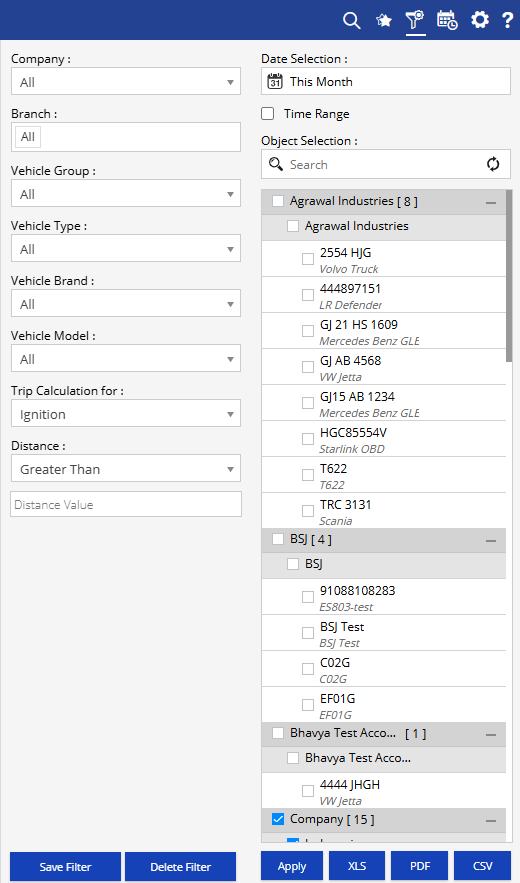
- Company: Select the required company.
- Date Selection: Select the required date or date range.
- Time Range: Enable to specify the required start and end time.
- Branch: Select the required branch.
- Vehicle Group: Select the required vehicle group.
- Vehicle Type: Select the required vehicle type.
- Vehicle Brand: Select the required vehicle brand.
- Vehicle Model: Select the required vehicle model.
- Trip Calculation for: Select the parameter used for trip calculation, such as Ignition.
- Distance: Select the distance condition and enter the required distance value.
- Object Selection: Search and select the required objects from the available hierarchy.
Additional options include Save Filter, Delete Filter, Apply, XLS, PDF, and CSV.
Report Layers
The Trip Violation Summary Report has two layers: Trip Violation Summary → Trip Violation Detail.
Layer 1 – Trip Violation Summary
Provides an overall view of trip activity and violation-related information for each selected object.
Key information includes Company, Branch, Object, Object Brand, Object Model, Driver, IMEI No, Distance, Running, Idle, Stop, Inactive, Working Days, Chart Data, First Ignition ON Time, First Ignition ON Location, Last Ignition OFF Time, Last Ignition OFF Location, Speed AVG, Speed MAX, Cost based on Distance/Duration, Immobilization, Overspeed, Alert(s), Approx Toll Cost, No of Trip, Playback, Harsh Cornering, Harsh Acceleration, Harsh Braking, and Toll Count.
Click the + icon against an object to view its trip details.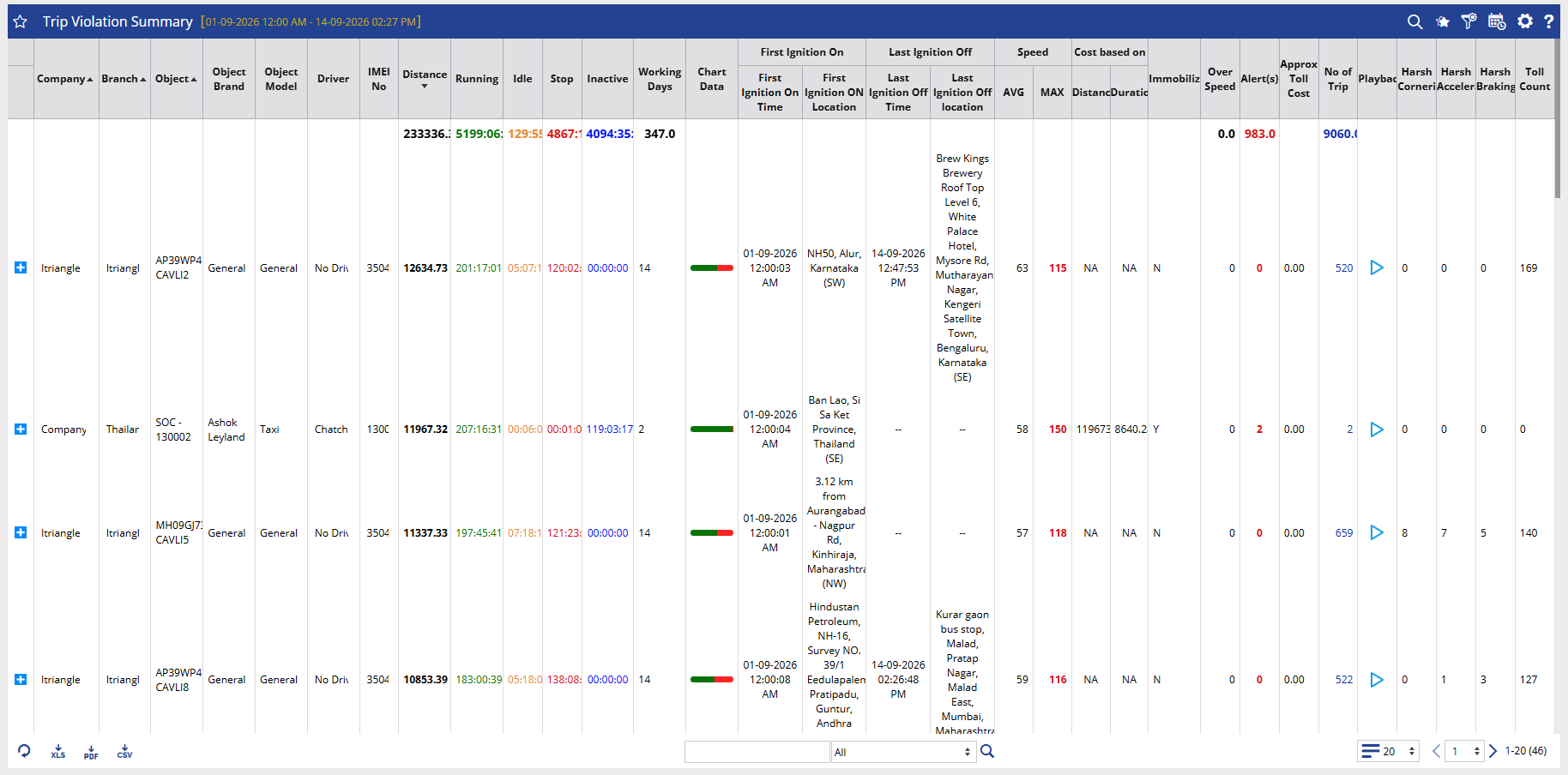
Layer 2 – Trip Violation Detail
Provides individual trip records for the selected object.
Key information includes Start Time, Start Location, Start Odometer, Start Coordinate, End Time, End Location, End Odometer, End Coordinate, Driver, Distance, Total Distance, Chart Data, Running, Idle, Stop, Inactive, Speed AVG, Speed MAX, Cost based on Distance/Duration, Overspeed, Immobilization, Alert(s), Approx Toll Cost, Show Path, Harsh Cornering, Harsh Acceleration, Harsh Braking, and Toll Count.
Use Show Path to view the travel path for the selected trip.
How to Read
Read the report from overall trip and violation summary → individual trip details.
Layer 1 – Trip Violation Summary
- Review distance, working days, running, idle, stop, and inactive activity.
- Check first ignition ON and last ignition OFF information.
- Review speed, overspeed, alerts, and immobilization.
- Check harsh driving events and toll information.
- Expand an object to investigate individual trips.
Layer 2 – Trip Violation Detail
- Review the start and end information for each trip.
- Analyze running, idle, stop, and inactive duration.
- Check speed, overspeed, alerts, and immobilization.
- Review harsh cornering, acceleration, braking, and toll count.
- Use Show Path to view the trip route.
Take Action
- Apply filters based on date, time, vehicle details, trip calculation, distance, and objects.
- Expand an Object to view its detailed trips.
- Review overspeed, alerts, immobilization, and harsh driving events for potential violations.
- Use Show Path to investigate the route of a specific trip.
- Export the report in XLS, PDF, or CSV format.
Important Notes
- The report is generated based on the selected date, time range, trip calculation, distance, and object filters.
- Trip Calculation for determines the basis used for calculating trips.
- Violation-related information is displayed based on the data available from the device and configured features.
- Show Path is available at the trip-detail level for reviewing the recorded trip route.