
The Overspeed Summary Report provides an overview of overspeed activity for selected vehicles during the selected period. It helps users identify how frequently vehicles exceeded the configured speed limit, the total duration of overspeeding, the maximum and average speed recorded, and the distance covered during overspeed events.
The report provides a summarized view for each object and allows users to open the detailed overspeed records for further investigation.
Benefits
- Monitor overspeed activity across vehicles.
- Identify vehicles with frequent overspeed events.
- Review the total duration of overspeeding.
- Identify the maximum and average speed recorded.
- Review the distance covered during overspeed events.
- Investigate individual overspeed events with detailed information.
How to Access
- Report-->Activity-->Overspeed Summary
Filters
Use the available filters to generate the report: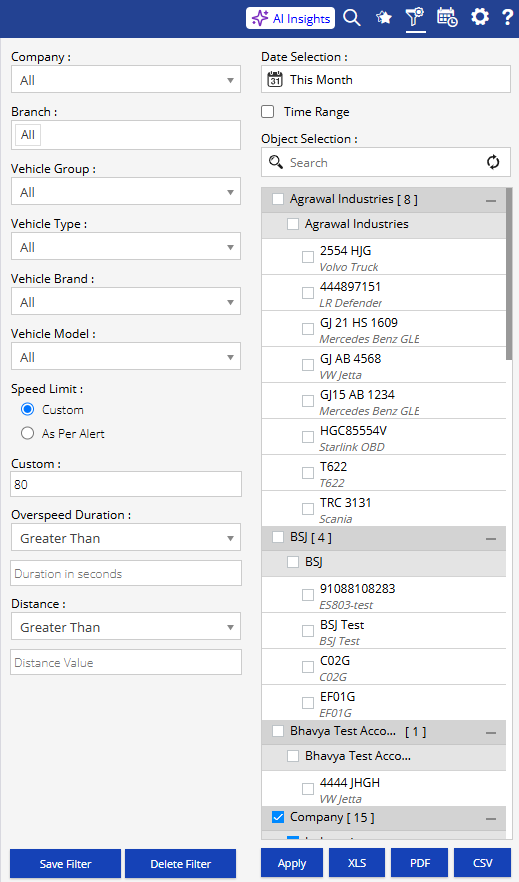
- Company: Select the required company.
- Branch: Select the required branch.
- Vehicle Group: Select the required vehicle group.
- Vehicle Type: Select the required vehicle type.
- Vehicle Brand: Select the required vehicle brand.
- Vehicle Model: Select the required vehicle model.
- Date Selection: Select the required date or reporting period.
- Time Range: Specify the required time range, if applicable.
- Speed Limit: Select the required speed limit option, such as Custom or As Per Alert.
- Overspeed Duration: Set the required overspeed duration criteria.
- Distance: Set the required distance criteria.
- Object Selection: Search and select the required objects from the available hierarchy.
Additional options include Save Filter, Delete Filter, Apply, XLS, PDF, and CSV.
Report Layers
The Overspeed Summary Report has two layers: Overspeed Summary → Overspeed Detail.
Layer 1 – Overspeed Summary
Provides an overall view of overspeed activity for each selected object.
Key information includes:
- Company displays the company associated with the vehicle.
- Branch shows the branch to which the vehicle is assigned.
- Object identifies the vehicle or object for which the overspeed information is displayed.
- Object Brand shows the vehicle's brand.
- Object Model displays the vehicle model.
- Driver shows the driver associated with the vehicle, if available.
- No Of Time indicates the total number of overspeed events recorded for the vehicle.
- Duration (HH:MM:SS) shows the combined duration of all overspeed events.
- MAX displays the highest speed recorded during the overspeed events.
- AVG shows the average speed recorded during the overspeed events.
- Distance indicates the total distance associated with the recorded overspeed activity.
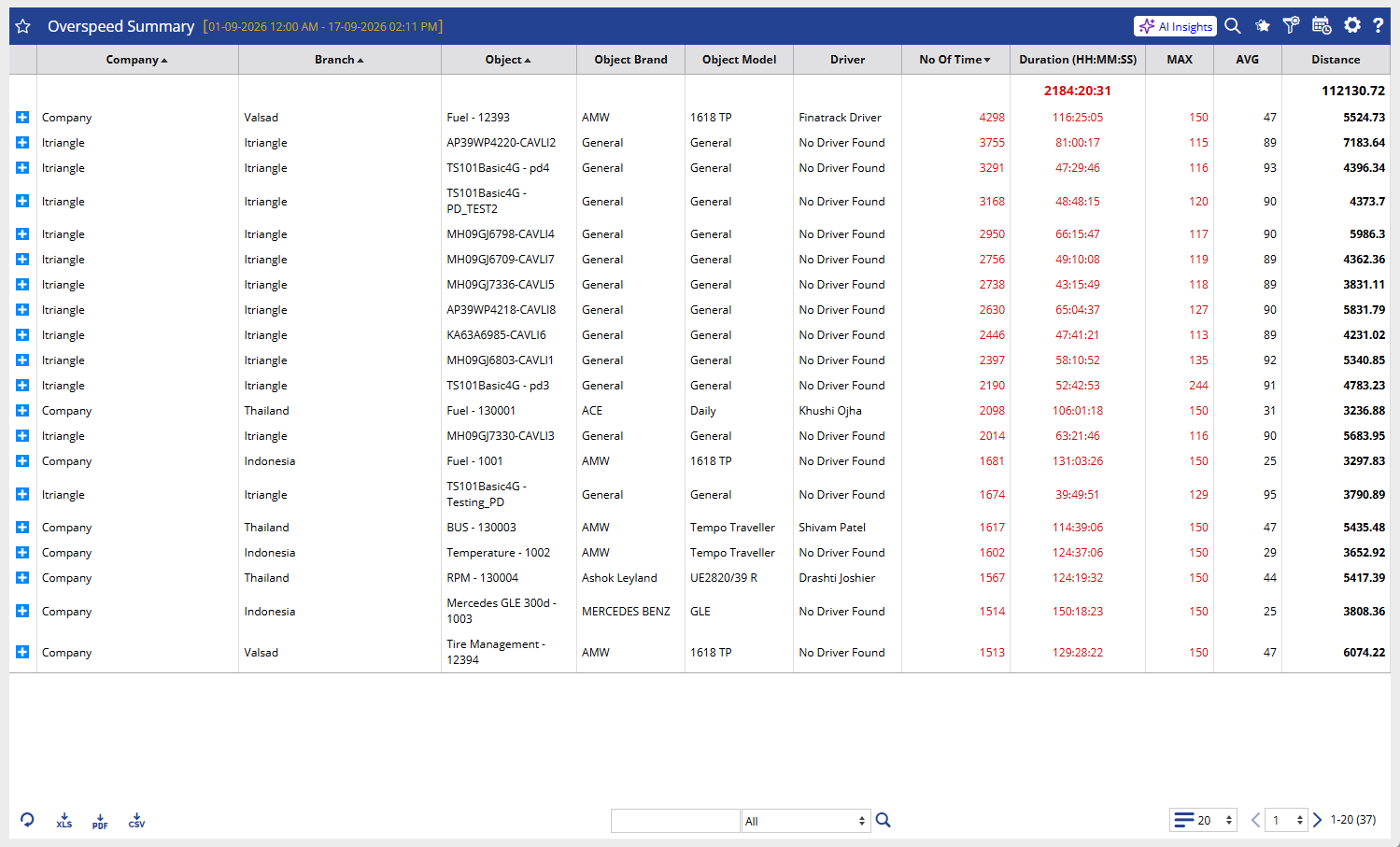
Click the + icon against an object to view its individual overspeed records.
Layer 2 – Overspeed Detail
Provides detailed information about the individual overspeed events recorded for the selected object.
Key information includes:
- Start Time shows when the overspeed event began.
- Start Location displays the location where the event started.
- End Time shows when the overspeed event ended.
- End Location displays the location where the event ended.
- Driver shows the driver associated with the event, when available.
- Employee No. displays the employee number associated with the driver, when available.
- Contact No. displays the driver's or employee's contact number, when available.
- Distance shows the distance travelled during the individual overspeed event.
- Duration (HH:MM:SS) indicates how long the vehicle remained in the overspeed condition.
- MAX shows the highest speed recorded during the individual event.
- AVG shows the average speed recorded during the individual event.
- Map provides an option to view the route or path associated with the overspeed event.
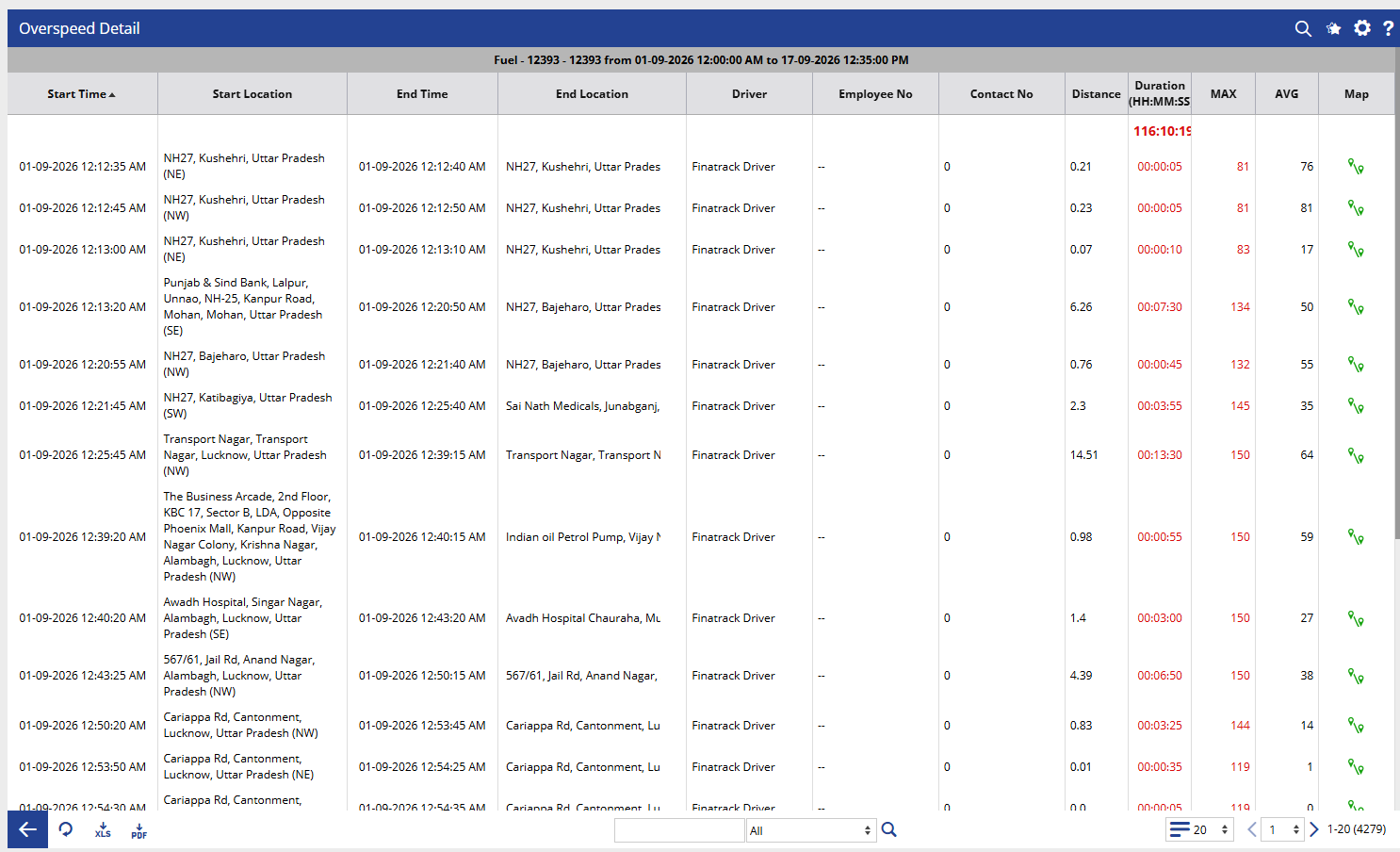
Use the Map option to review the route or location associated with the overspeed event.
How to Read
Read the report by first reviewing the overall overspeed activity for each object and then opening the object to investigate individual events.
Overspeed Summary
- Check the Company, Branch, and Object to identify the vehicle.
- Review Driver information to identify the associated driver.
- Check No Of Time to understand how many overspeed events were recorded.
- Review Duration to understand the total time spent overspeeding.
- Check MAX to identify the highest speed recorded.
- Review AVG to understand the average speed during overspeed events.
- Check Distance to understand the distance associated with the overspeed activity.
- Click the + icon to investigate individual overspeed events.
Overspeed Detail
- Check Start Time and Start Location to identify when and where the overspeed event started.
- Check End Time and End Location to identify when and where the event ended.
- Review Driver, Employee No., and Contact No. to identify the associated driver information.
- Check Distance and Duration to understand the extent of the individual event.
- Review MAX and AVG to understand the speed recorded during that event.
- Use Map to view the route or location associated with the event.
Take Action
- Review vehicles with a high number of overspeed events.
- Check vehicles with a high total overspeed duration.
- Investigate events with unusually high MAX speeds.
- Open the detail layer to review the time and location of individual overspeed events.
- Review driver information when investigating specific overspeed events.
- Use Map to verify the route associated with an event.
- Export the report in XLS, PDF, or CSV format.
Important Notes
- The report contains two layers: Overspeed Summary → Overspeed Detail.
- The report results depend on the selected Company, Branch, Vehicle Group, Vehicle Type, Vehicle Brand, Vehicle Model, Date Selection, Time Range, Speed Limit, Overspeed Duration, Distance, and Object Selection.
- No Of Time represents the number of overspeed events recorded during the selected period.
- Duration represents the recorded overspeed duration.
- MAX and AVG are based on the speed data received from the tracking device.
- Detailed event information is available by expanding the required object.
- The report can be exported in XLS, PDF, and CSV formats.