
The Geofence to Geofence Trip Summary provides a consolidated view of trips made by vehicles from one geofence to another during the selected period. It helps users understand the number of trips, distance travelled, running time, idle time, stop time, inactive time, and total trip duration for each vehicle and geofence combination.
The report is useful for analyzing vehicle movement between defined geofences and identifying travel patterns, operational activity, and time spent during trips.
Benefits
- Monitor trips between selected start and end geofences.
- Review the number of trips made by each vehicle.
- Analyze total distance travelled between geofences.
- Compare running, idle, stop, and inactive durations.
- Review overall trip duration for operational analysis.
How to Access
- Report-->Geofence-Address--> Geofence to Geofence Trip Summary
Filters
Use the available filters to generate the report: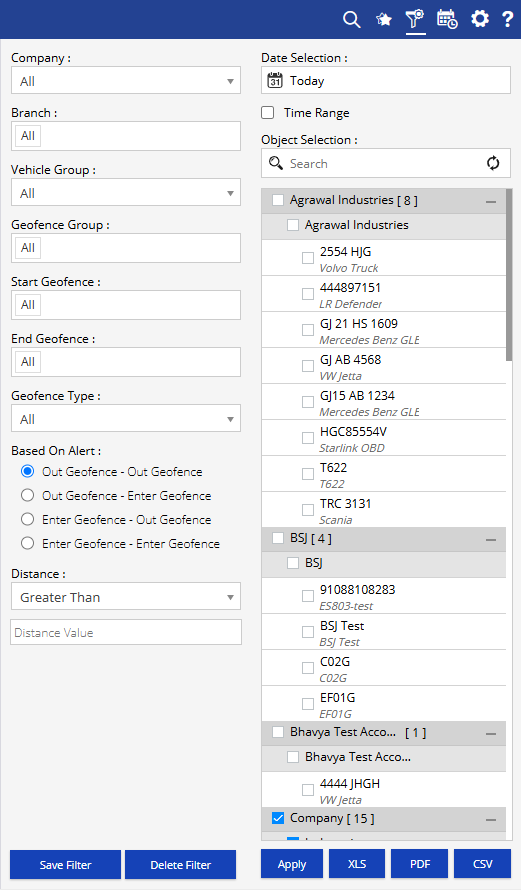
- Company: Select the required company.
- Date Selection: Select the required date or date range.
- Time Range: Enable this option when a specific time range is required.
- Branch: Select the required branch.
- Vehicle Group: Select the required vehicle group.
- Geofence Group: Select the required geofence group.
- Start Geofence: Select the geofence from which the trip should start.
- End Geofence: Select the geofence where the trip should end.
- Geofence Type: Select the required geofence type.
- Object Selection: Select the required vehicles or tracking objects.
- Based On Alert: Select the required geofence transition condition:
- Out Geofence - Out Geofence
- Out Geofence - Enter Geofence
- Enter Geofence - Out Geofence
- Enter Geofence - Enter Geofence
- Distance: Select the required distance condition and enter the distance value.
Additional options include Save Filter, Delete Filter, Apply, XLS, PDF, and CSV.
Report Layers
The Geofence to Geofence Trip Summary has two levels of information:
Layer 1 – Geofence to Geofence Trip Summary
Provides a consolidated summary of trips grouped by company, branch, vehicle, driver, and start/end geofences.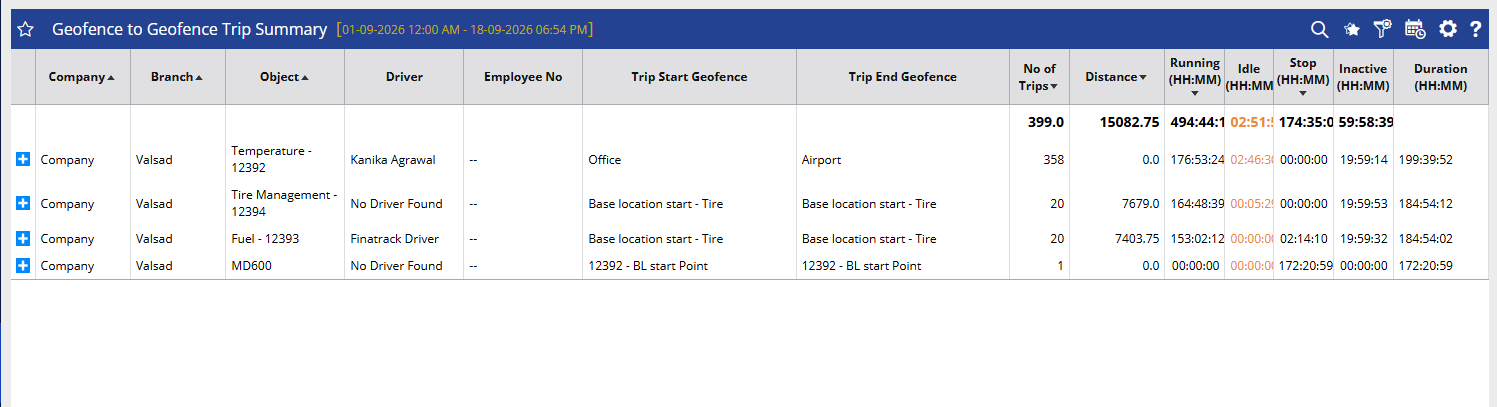
Layer 2 – Geofence to Geofence Trip Detail
Click the expand (+) option for a summary record to view individual trips between the selected start and end geofences.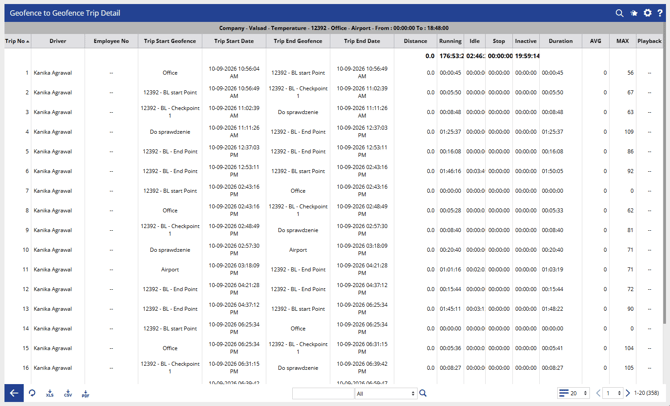
How to Read
Geofence to Geofence Trip Summary
- Company identifies the company under which the trips are recorded.
- Branch shows the branch associated with the vehicle.
- Object identifies the vehicle or tracking object for which the trips are generated.
- Driver shows the driver associated with the vehicle during the selected trips.
- Employee No displays the employee number associated with the driver, where available.
- Trip Start Geofence identifies the geofence from which the trip sequence starts.
- Trip End Geofence identifies the geofence where the trip sequence ends.
- No of Trips shows the total number of trips recorded between the selected start and end geofences.
- Distance indicates the total distance travelled across the recorded trips.
- Running (HH:MM) shows the total time for which the vehicle was in motion.
- Idle (HH:MM) indicates the total time for which the vehicle remained idle.
- Stop (HH:MM) shows the total time for which the vehicle was stopped.
- Inactive (HH:MM) indicates the total duration during which the tracking device was inactive or not reporting.
- Duration (HH:MM) shows the overall duration of the recorded trips between the selected geofences.
Geofence to Geofence Trip Detail
- Trip No. identifies the individual trip within the selected summary.
- Driver shows the driver associated with the trip.
- Employee No displays the employee number, where available.
- Trip Start Geofence identifies the geofence where the individual trip started.
- Trip Start Date indicates when the trip started.
- Trip End Geofence identifies the geofence where the individual trip ended.
- Trip End Date indicates when the trip ended.
- Distance shows the distance covered during the individual trip.
- Running indicates the vehicle's running time during the trip.
- Idle shows the idle time recorded during the trip.
- Stop indicates the time for which the vehicle remained stopped.
- Inactive shows the period during which the device was inactive or not reporting.
- Duration displays the total duration of the individual trip.
- AVG displays the average value available for the trip, where applicable.
- MAX displays the maximum value recorded for the trip, where applicable.
- Playback allows the user to review the vehicle's movement associated with the selected trip.
Take Action
- Apply start and end geofence filters to focus on specific routes between locations.
- Use Based On Alert to define the geofence transition pattern considered for the trip.
- Review No of Trips to understand how frequently vehicles travelled between the selected geofences.
- Compare Distance and Duration to analyze travel activity.
- Review Running, Idle, Stop, and Inactive values to understand how the vehicle spent its trip time.
- Expand a summary record to investigate individual trips and their timestamps.
- Use Playback from the detailed trip view when movement verification is required.
- Export the report in XLS, PDF, or CSV format for further analysis or sharing.
Important Notes
- The report is generated according to the selected date, time, object, and geofence filters.
- Trip Start Geofence and Trip End Geofence are determined based on the selected Based On Alert condition.
- No of Trips represents the number of individual trips grouped under the corresponding summary record.
- Distance and duration values depend on the tracking data available for the selected vehicles and period.
- Running, Idle, Stop, and Inactive durations are calculated from the available tracking data.
- The detail layer provides the individual trip records contributing to the summary.
- Playback availability depends on the historical tracking data available for the selected vehicle and period.