
The State of Health alert is used to notify users when the State of Health (SoH) value reported by the connected battery or BMS reaches the configured condition. This helps users monitor battery health and identify when the battery's health falls below or rises above a defined percentage.
Parameters Considered (Prerequisites)
- Device Compatibility: The Device should be capable to send the SOH data.
How to Configure
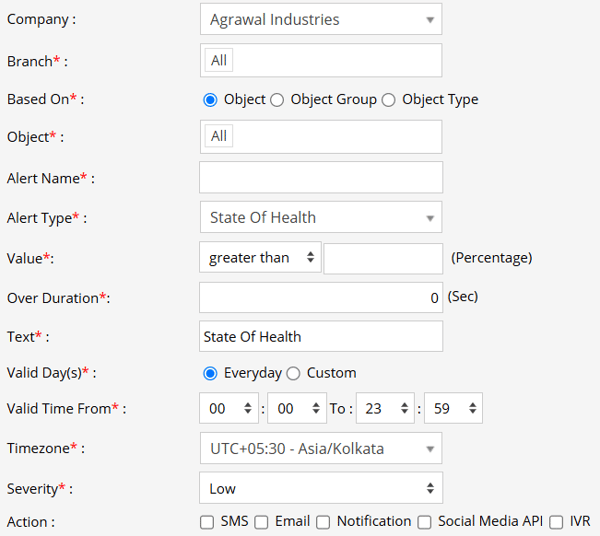
- Select the correct Company and Branch for whom the alert is to be configured.
- Based On: Choose on what you want to base the alert configuration (Object, Object Group, Object Type).
- Object: Select individual vehicles for whom you want the alert to generate.
- Object Group: Select a group of vehicles for whom you want the alert to generate.
- Object Type: Select vehicle or object type for whom you want the alert to generate.
- Select the Object based on the previous step selection.
- Set an Alert Name for identification of the alert.
- Select the Alert Type as State Of Health.
-
Under Value, select the required comparison condition:
- Greater than: The alert is triggered when the SOH value is greater than the configured percentage.
- Less than: The alert is triggered when the SOH value is less than the configured percentage.
- In Over Duration, mention the number of seconds for which the configured condition must continuously remain valid before the alert is triggered.
- In the Text field, enter the message that will be displayed when the alert is triggered.
- Select the Valid Days, Everyday or Custom.
- Everyday: This alert will be triggered, everyday in case of a violation in accordance to these parameters set.
- Custom: Mark the checkboxes of the days, when you want this alert to be triggered for. (eg., Sun, Mon and Sat)

- Enter the Valid Time From and To. The alert will be generated inside the time range that you have selected.
- Select the Timezone.
- Select the Severity of the alert (Low, Medium, or High).
- Mark the checkboxes of the medium via which you want the Action or Notification to be sent. (eg., SMS, Email or Notification)
- SMS: To receive an alert by SMS, enable the checkbox, enter the phone numbers.
- Email: To receive an alert by Email, enable the checkbox, enter the recipients of the email.
- Notification: To receive an alert on the system Push Notification, enable checkbox.
- From Users, select the users that will receive the notification.
- From Notification Sound. Select the sound from the drop-down that will be played for this notification.
- Social Media API: To receive the alert through WhatsApp or Telegram, enable the checkbox and configure the required gateway and recipient details.
- WhatsApp: Select to send notification via WhatsApp
- In Recipient Number, enter the recipient's mobile number along with the country code.
- To add multiple recipients, separate the mobile numbers using a comma (,).
- Telegram: Select Telegram to send notification via Telegram.
- In Telegram Chat ID, enter the Chat ID to which the alert should be sent.
- To send the alert to multiple Telegram chats, separate the Chat IDs using a comma (,).
- WhatsApp: Select to send notification via WhatsApp
- IVR: To receive alerts through IVR ( automated voice call ), enable the checkbox.
- In To Numbers, enter the phone numbers.
- Click Save 💾 icon. to save the alert configuration.
Please Note: To receive alerts through SMS, Email, Social Media API, or IVR, the respective API must be configured at the Admin, Reseller, or Company level.