
The Longtime Driving Warning alert is used to notify users when the Driver Monitoring System (DMS) detects that a driver has been driving continuously for an extended period. This alert helps fleet operators monitor prolonged driving activity, identify situations where drivers may require a break, and promote safer driving practices.
Parameters Considered (Prerequisites)
- Driver Monitoring System (DMS): The selected vehicle must be equipped with a supported DMS.
- Driver Detection: The DMS must be able to identify and monitor the driver during vehicle operation.
- Longtime Driving Data: The DMS must provide the required driving-duration information to detect prolonged driving activity.
How to Configure
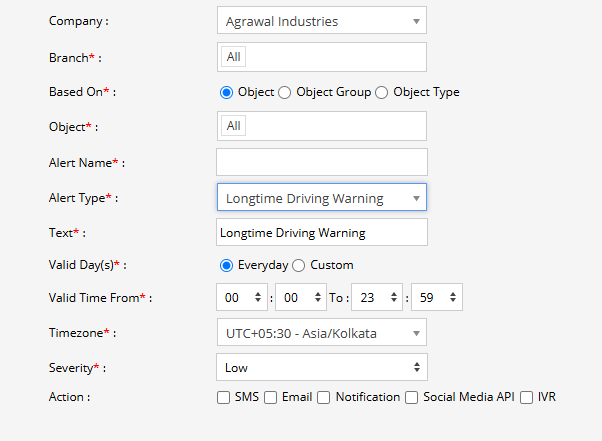
- Select the correct Company and Branch for whom the alert is to be configured.
- Based On: Choose what you want to base the alert configuration on (Object, Object Group, Object Type).
- Object: Select individual vehicles/objects for whom you want the alert to generate.
- Object Group: Select a group of vehicles/objects for whom you want the alert to generate.
- Object Type: Select a vehicle or object type for whom you want the alert to generate.
- Select the Object based on the previous step selection.
- Set an Alert Name for identification of the alert.
- Select the Alert Type as Longtime Driving Warning.
- In the Text field, enter the message that will be displayed when the Longtime Driving Warning alert is triggered.
- Select the Valid Day(s) as Everyday or Custom.
- Everyday: The alert will be triggered every day when the longtime driving condition is detected.
- Custom: Select the specific days on which you want this alert to be triggered.
- Enter the Valid Time From and To. The alert will be generated only within the selected time range.
- Select the required Timezone.
- Select the Severity of the alert (Low, Medium, or High).
- Under Action, select the medium through which the alert or notification should be sent (SMS, Email, Notification, Social Media API, or IVR).
- SMS: To receive the alert by SMS, enable the checkbox and enter the required phone numbers.
- Email: To receive the alert by email, enable the checkbox and enter the email recipients.
- Notification: To receive the alert as a system push notification, enable the checkbox and select the users who should receive it.
- Social Media API: To receive the alert through WhatsApp or Telegram, enable the checkbox and configure the required gateway and recipient details.
- IVR: To receive the alert through an automated voice call, enable the checkbox and enter the required phone numbers.
- Click the Save 💾 icon to save the alert configuration.
Please Note: To receive alerts through SMS, Email, Social Media API, or IVR, the respective API/gateway must be configured at the Admin, Reseller, or Company level.
Example
A driver operates a vehicle continuously for an extended period. The DMS monitors the driver's driving duration and detects that the driver has been driving for a prolonged period. The Longtime Driving Warning alert is then triggered, and the configured users receive a notification, allowing the fleet operator to take appropriate action, such as recommending a break to the driver.