
The Driver Changed alert is used to notify users when the Driver Monitoring System (DMS) detects a change in the driver operating the vehicle. This alert helps fleet operators monitor driver changes, maintain accurate driver activity records, and ensure that vehicle operation can be associated with the appropriate driver. 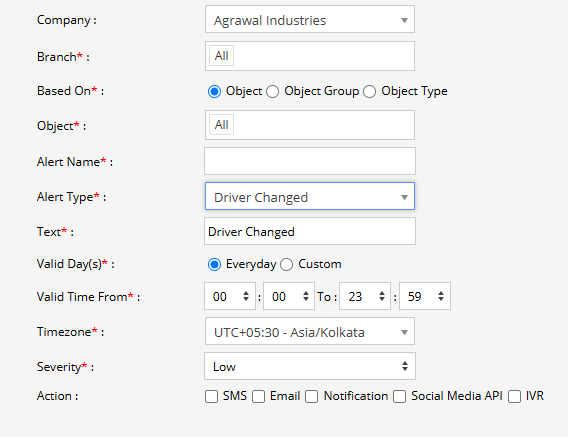
Parameters Considered (Prerequisites)
- Driver Monitoring System (DMS): The selected vehicle must be equipped with a supported DMS.
- Driver Detection: The DMS must be capable of identifying and distinguishing drivers.
- Driver Change Data: The system must receive the corresponding driver change event from the DMS or connected device.
How to Configure
- Select the correct Company and Branch for whom the alert is to be configured.
- Based On: Choose what you want to base the alert configuration on (Object, Object Group, Object Type).
- Object: Select individual vehicles/objects for whom you want the alert to generate.
- Object Group: Select a group of vehicles/objects for whom you want the alert to generate.
- Object Type: Select a vehicle or object type for whom you want the alert to generate.
- Select the Object based on the previous step selection.
- Set an Alert Name for identification of the alert.
- Select the Alert Type as Driver Changed.
- In the Text field, enter the message that will be displayed when the Driver Changed alert is triggered.
- Select the Valid Day(s) as Everyday or Custom.
- Everyday: The alert will be triggered every day when the DMS detects a driver change.
- Custom: Select the specific days on which you want this alert to be triggered.
- Enter the Valid Time From and To. The alert will be generated only within the selected time range.
- Select the required Timezone.
- Select the Severity of the alert (Low, Medium, or High).
- Under Action, select the medium through which the alert or notification should be sent (SMS, Email, Notification, Social Media API, or IVR).
- SMS: To receive the alert by SMS, enable the checkbox and enter the required phone numbers.
- Email: To receive the alert by email, enable the checkbox and enter the email recipients.
- Notification: To receive the alert as a system push notification, enable the checkbox and select the users who should receive it.
- Social Media API: To receive the alert through WhatsApp or Telegram, enable the checkbox and configure the required gateway and recipient details.
- IVR: To receive the alert through an automated voice call, enable the checkbox and enter the required phone numbers.
- Click the Save 💾 icon to save the alert configuration.
Please Note: To receive alerts through SMS, Email, Social Media API, or IVR, the respective API/gateway must be configured at the Admin, Reseller, or Company level.
Example
A vehicle is being operated by one driver, and another driver subsequently takes control of the vehicle. The DMS detects the change in the identified driver and sends the corresponding event to the system. The Driver Changed alert is triggered, and the configured users receive a notification, allowing the fleet operator to maintain visibility of driver changes and driver activity.